
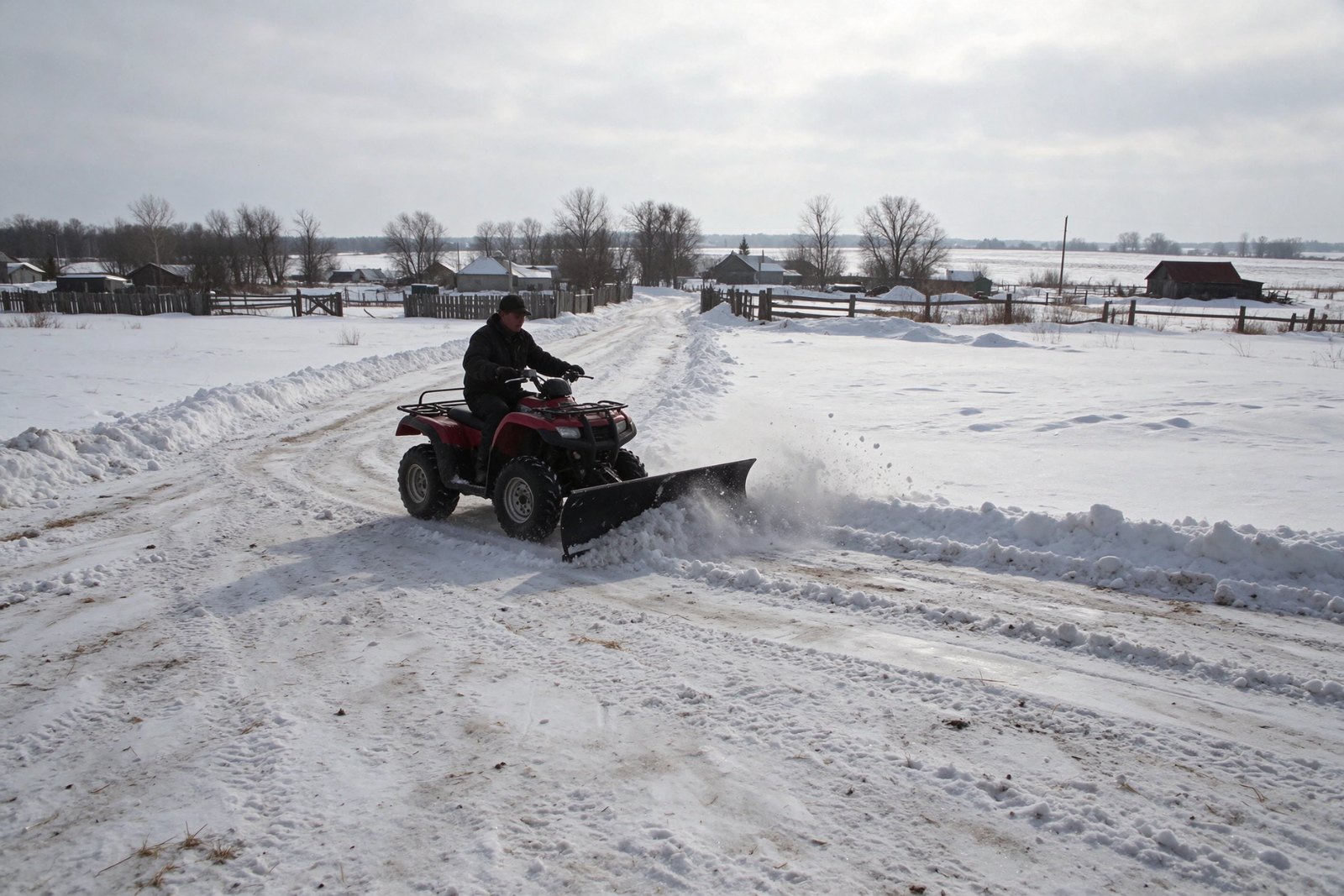
A farm ATV earns its keep in winter if it is prepared before the first hard freeze, not after. The three areas that decide whether it starts, steers and stops on a January morning are the plow setup, the battery and the cold-start routine.
Plow setup
- Match the blade to the machine. A blade wider than the track pushes snow the machine cannot steer against. Width equal to or slightly less than the tyre track is the practical rule.
- Check the lift mechanism. Manual lift is reliable and slow; a winch lift is faster but adds load to the electrical system. Either way, test the full raise and lower range before snow arrives.
- Weigh the rear. A front blade on an empty quad is a see-saw. Ballast, chains or a rear weight box keeps the rear tyres planted.
Battery and cold start
Lead-acid starting batteries lose a large share of their capacity at low temperature. A maintainer on a timer, a warm shed and clean terminals solve most winter no-start complaints. For diesel or large-displacement petrol engines, a block heater is cheaper than a jump-start at 6 a.m.
The cold-start routine
Choke or enrichment as specified, a short warm-up before load, and no full-throttle running until the oil has circulated. On a CVT machine, a cold belt is stiff; gentle running for the first few minutes extends belt life.
MODOU VEHICLE specifies water-cooled engines and shaft drive on the MD-XL4 and MD-XL5 to keep drivetrain behaviour consistent in cold weather, where a belt drive can slip or glaze. For lighter snow work, the 350cc MD-D3H with a front blade covers lanes and yards.
Storage matters too
Machines that sit for weeks should be stored dry, with fuel stabilised, tyres off soft ground and the battery on a maintainer. A ten-minute routine in November saves a service call in January, and it keeps a working machine working.