
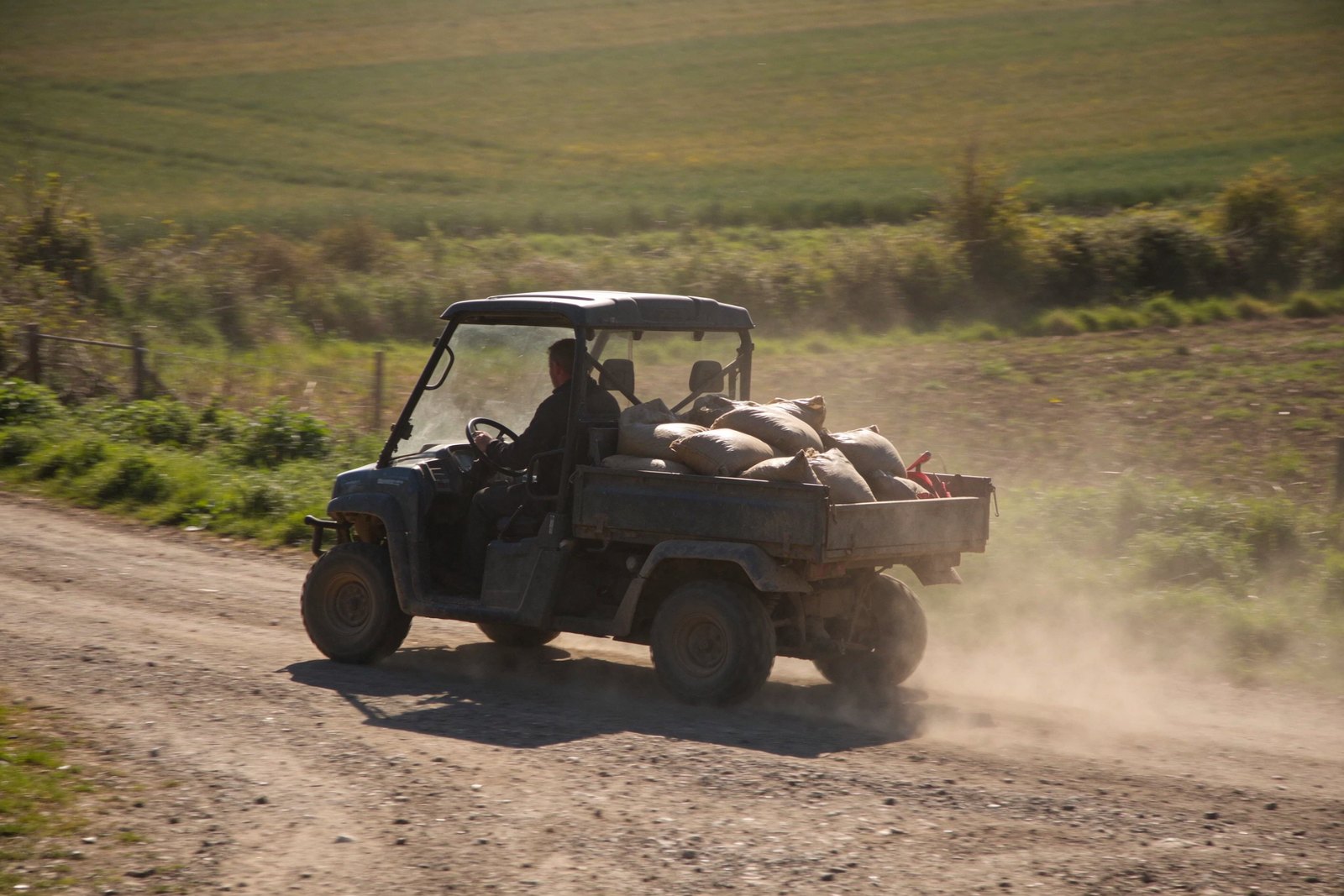
Three launches in the past month have made towing capacity the most-quoted number in the farm ATV market: CFMOTO’s GEN4 C4 at 612 kg, the C6 PRO at 830 kg and Loncin’s UWOLF550 at 4,409 lb. Rack ratings have moved too, to 40 kg front and 80 kg rear on the C4 and 55 kg front and 110 kg rear on the C6 PRO.
Those numbers look like progress, and they are. But a buyer comparing machines across brands needs to know what sits behind each figure.
Four questions that turn a number into a capability
- Towing with or without trailer brakes? Many ratings assume a braked trailer. Unbraked towing is usually much lower, and on a slope it is the difference between control and a runaway.
- What is the hitch? A drawbar, a three-point link and a receiver hitch load the chassis differently. A rating quoted for a specific hitch type does not transfer to another.
- What is the gross vehicle weight rating? Rack load, operator, passenger and fuel all count against it. A 110 kg rear rack plus a 90 kg rider plus a trailer tongue weight can exceed the designed limit quickly.
- What stops it? Engine braking and brake size matter more than engine power once a trailer is rolling downhill.
Why racks are rated lower than buyers expect
A rear rack on a quad is mounted above and behind the rear axle, so load there has a long lever arm. That is why 80 kg is a sensible rating while the same machine can tow 600 kg on a trailer with its own axle. Buyers who pile 200 kg on the rack are changing the machine’s centre of gravity and its steering behaviour.
MODOU VEHICLE publishes rack and hitch ratings for each model and states the intended duty: the 350cc MD-D3H for repeated light hauling, the 700cc MD-XL5 for heavier tow loads with a four-wheel-drive chassis. Buyers get a machine matched to the job rather than a headline figure.
The practical rule
Specify the job first: the heaviest single load, the steepest slope, the longest trip and the trailer you already own. Then match the machine. A 612 kg rating used every day beats an 830 kg rating used once a month with the wrong trailer attached.