
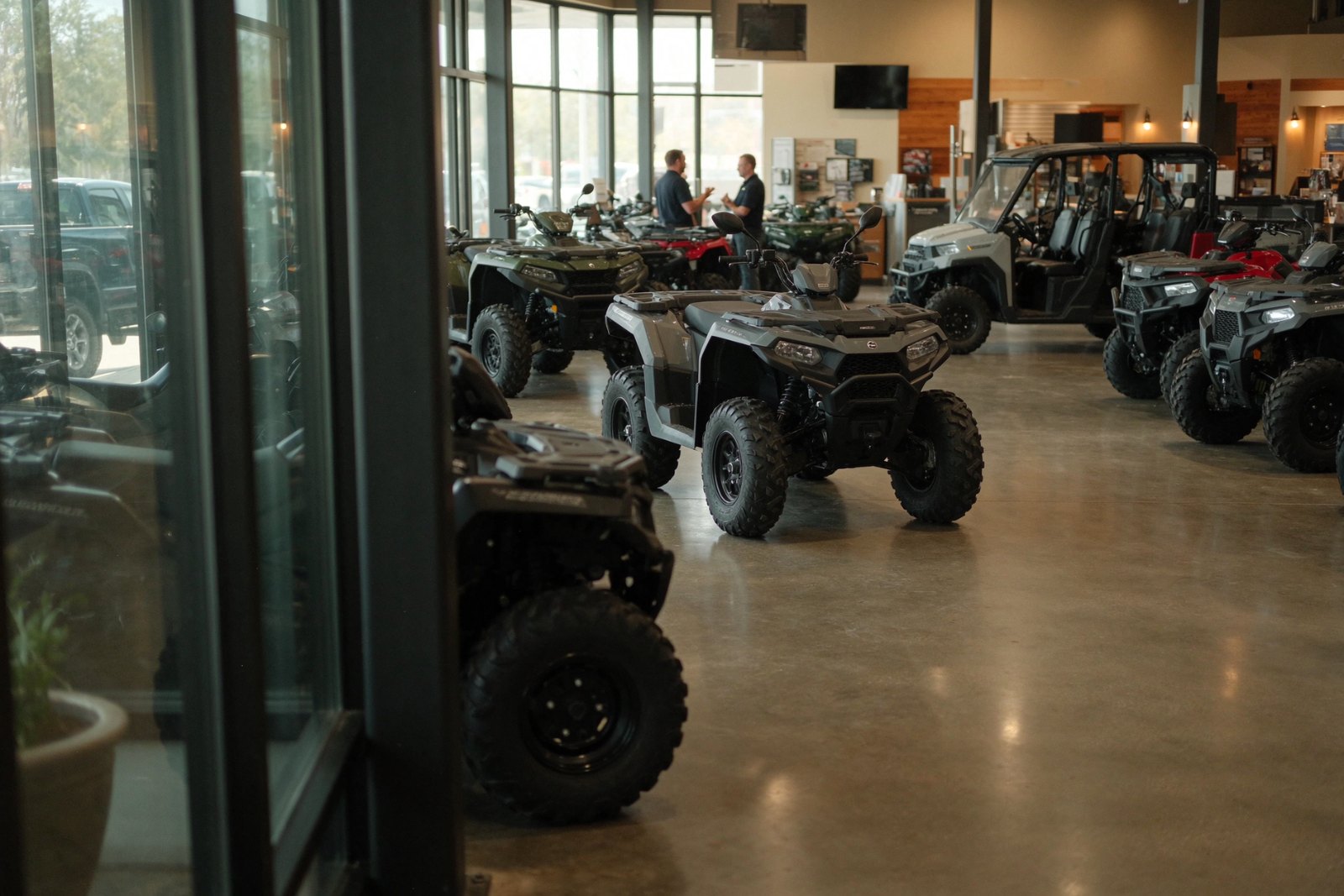
One estimate puts the US ATV and UTV market at $8.05 billion in 2025 across roughly 665,000 vehicles, an average transaction of about $12,106, rising to $12.09 billion by 2035 at a 4.15% compound rate, per the market summary published this month. Utility side-by-sides account for 40% of that value, and the South accounts for 38%.
What actually changed
- Utility side-by-sides carry the value. About $3.22 billion of 2025 spend sits in utility SxS, with sport and recreational growing fastest at around 5% a year.
- The South is the biggest region. 38% of value in 2025, growing about 4.5% a year toward $4.75 billion by 2035.
- Brand concentration is high. Polaris at roughly 40%, BRP at 25% and Honda at 9% means the top three hold about 74%.
- Tariffs are in the price. Import duties on materials and machines are now part of the transaction price, not a footnote.
Regional concentration matters more than national totals for anyone planning inventory. A dealer in the South is selling into the deepest pool of demand in the country, which means the competitive pressure is highest there too, and the differentiation has to come from service, financing and the ability to specify a machine for the actual job.
For an importer, the same data argues for a narrow, well-supported range rather than a long catalogue. In a market where three brands hold three quarters of the value, the challenger’s advantage is price plus availability plus the willingness to configure a machine the big three will not build at that price point.
Where MODOU VEHICLE fits
At MODOU VEHICLE (Yongkang Modou Vehicle Co., Ltd.) we build the practical end of this market: agricultural ATVs from 200cc to 350cc, electric ATVs, gasoline ATVs and utility machines that farms, estates and rental operators actually put to work. The MD-D3H is the model most of our dealers specify for heavy utility work where payload and drivetrain durability carry the day. Every unit leaves the line with a shaft or chain drivetrain tuned for load, a locking rear differential where the terrain demands it, and a rack and towing package sized to the engine, not to the brochure.
The bottom line
Read the regional numbers before you read the national ones. Demand is not evenly distributed, and neither is competition.