
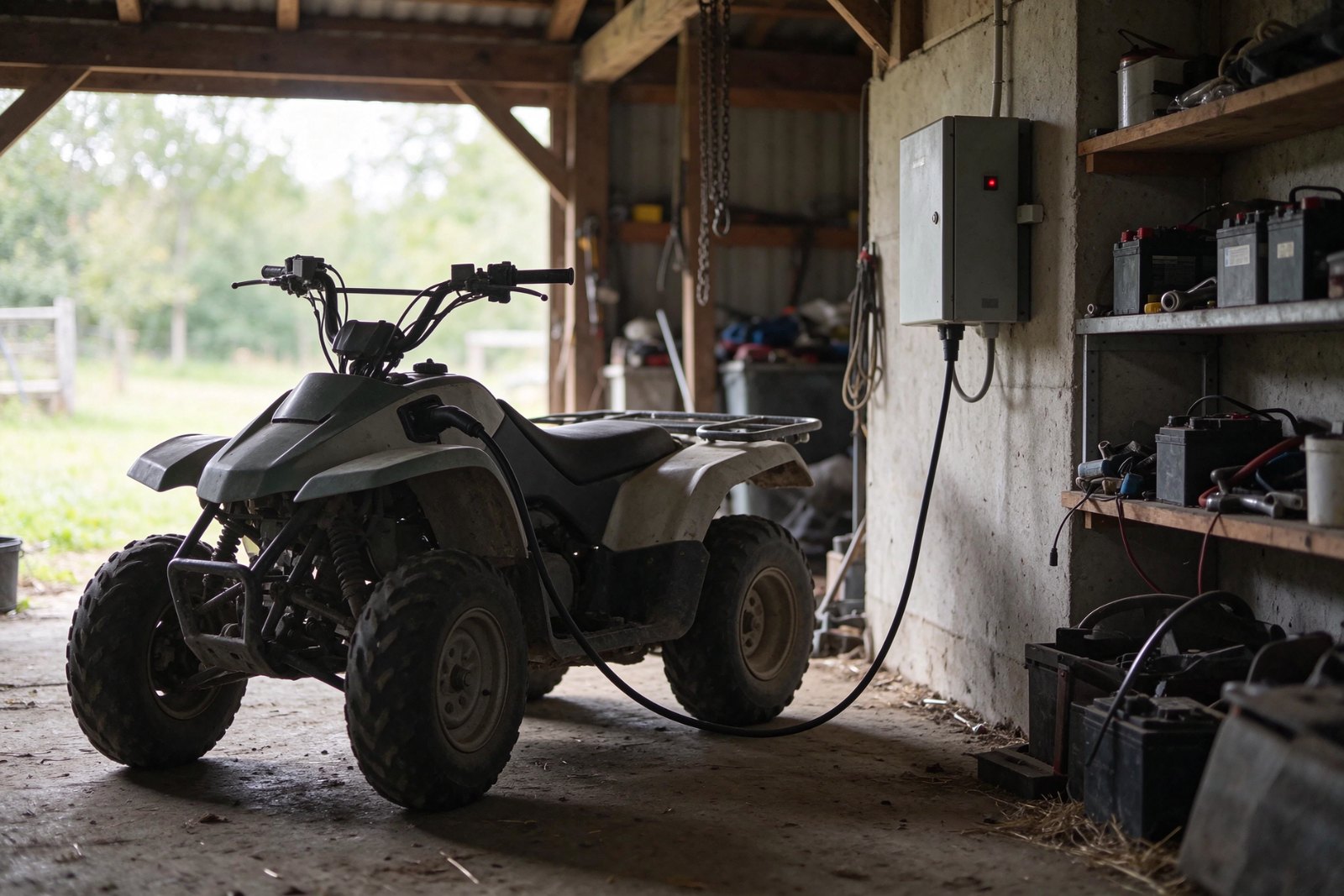
The case for an electric utility vehicle is usually made with a picture of a quiet machine in a barn. The case that actually gets signed is made with a spreadsheet, and the inputs are now public: a 19 kWh pack and 68 miles of range on one side, Greenworks’ specification, a 15.29 kWh pack and 110 km on another, CFMOTO’s, and a 10-25 kW class with 280 mm clearance on the third, the OEM launch data.
What actually changed
- Energy per hour, not miles per gallon. Range divided by pack size gives a usable kWh-per-km figure to price against your electricity tariff.
- Idle cost goes to zero. A diesel side-by-side burns fuel while the operator loads, talks or waits; an EV does not.
- Service interval shifts. No oil, filters or belts, but brake, tyre and battery-care work remains.
- Battery is the residual value. Warranty terms on the pack decide what the machine is worth in year five.
A worked example makes the point. A 15 kWh pack delivering roughly 100 km of real-world utility work implies about 0.15 kWh per km before charging losses; at a typical farm tariff that is a few cents per kilometre, against a diesel machine that will use well over a litre for the same distance at part load. The gap is largest exactly where utility vehicles spend their lives: short trips, repeated stops, low average speed and long idle periods.
The counterweights are capital cost and charging infrastructure. If the farm already has a three-phase supply and a spare circuit, the second number is small. If it does not, that cost belongs in the comparison, not in a footnote.
Where MODOU VEHICLE fits
At MODOU VEHICLE (Yongkang Modou Vehicle Co., Ltd.) we build the practical end of this market: agricultural ATVs from 200cc to 350cc, electric ATVs, gasoline ATVs and utility machines that farms, estates and rental operators actually put to work. The MD-S8E is the model most of our dealers specify for electric utility work where the daily loop is fixed and the charger is already on site. Every unit leaves the line with a shaft or chain drivetrain tuned for load, a locking rear differential where the terrain demands it, and a rack and towing package sized to the engine, not to the brochure.
The bottom line
Do the arithmetic on your own loop, with your own tariff. A generic payback figure is marketing; your own kilowatt-hours are a decision.