
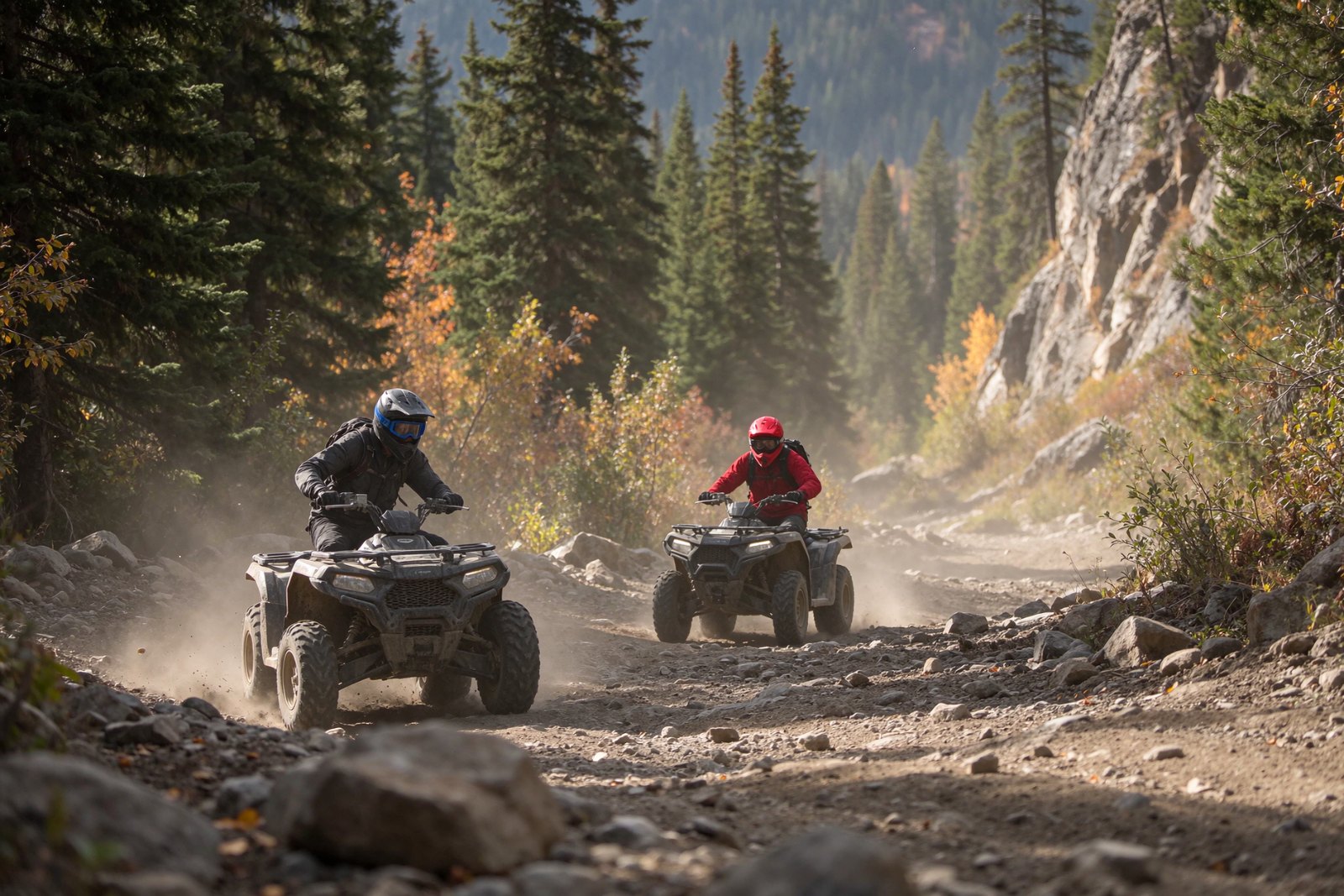
Dune riders develop a specific set of habits because sand punishes mistakes immediately: too much throttle digs in, too little stalls, and the wrong line puts the machine nose-down in a bowl. Those habits are directly useful on a farm, where the same physics apply at lower speed with higher stakes.
Three transferable skills
- Smooth throttle. In sand, a stab of throttle breaks traction and buries the rear wheels. On wet grass or a slope with a trailer, the same stab spins the wheels and loses steering. Progressive input is the fix in both places.
- Weight transfer. Moving body weight forward for traction, back for flotation. On a farm that becomes shifting weight to keep the front wheels planted on a descent, or to load the rear tyres while towing.
- Line choice. Reading the terrain several metres ahead rather than reacting at the last moment. On a farm this is choosing the drier track across a gateway instead of the rutted one.
What does not transfer
Speed. Dune riding rewards momentum; farm work punishes it. The discipline is to take the smoothness and leave the pace behind. A farm rider who carries dune speed into a yard with livestock around is creating the exact incident that regulators use to restrict access.
MODOU VEHICLE‘s ATVs, including the 350cc MD-D3H and the 500cc MD-XL4, are specified with predictable low-speed control and engine braking rather than aggressive power delivery, because that is what makes both terrain types manageable.
Learning where it is safe
A dune area or a closed training course is the right place to build these habits, with instruction and protective gear. Practising on a working farm with stock, machinery and children present is how skills get learned badly.