
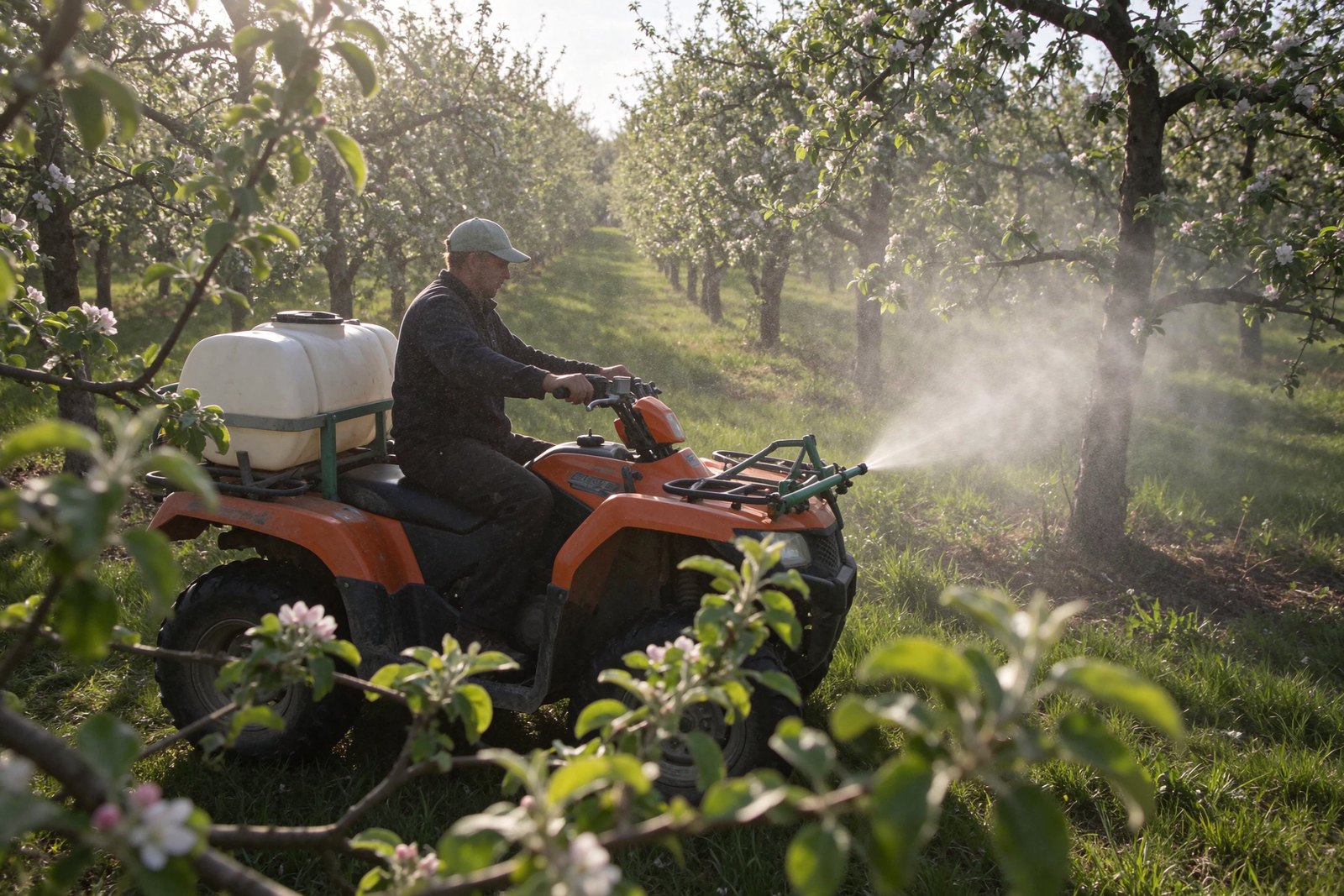
Precision agriculture usually gets discussed in the context of tractors with guidance and section control. On smaller holdings, orchards and vineyards, the practical version is simpler: a well-chosen sprayer, spreader or sensor package mounted on a utility ATV, doing repeated passes accurately and cheaply.
The four constraints
- Rack rating. A 100-litre sprayer weighs over 100 kg full. That is at or beyond the rear rack limit on many quads, which is why trailed or axle-mounted tanks exist.
- Electrical draw. Pumps, controllers and section valves add load. Check the alternator or battery capacity, and use a fused, dedicated circuit.
- Stability. Liquid moves. A half-full tank sloshing on a slope changes the machine’s balance; baffled tanks and lower mounting points help.
- Control interface. Rate controllers, GPS light bars and section shutoffs need power, mounting and a screen the operator can read while working.
What works well on a quad
Boomless nozzles for fence lines and small orchards, spot sprayers for weeds, spinner spreaders for fertiliser on pasture, and simple sensor packages for soil moisture or canopy temperature. The common thread is low weight, low power draw and short, repetitive passes.
MODOU VEHICLE builds the agricultural ATV range around exactly these tasks. The 350cc MD-D3H carries a rear rack load and tows a small trailer for a heavier tank, while the 72V MD-D2E suits tunnel and polytunnel work where exhaust emissions are unwelcome.
Calibration beats hardware
The most common failure is not the machine; it is an uncalibrated sprayer. Measure the output per nozzle over a fixed distance, check the speed you actually travel at, and record the rate. A cheap sprayer calibrated properly outperforms an expensive one used on guesswork.
What to buy first
Start with the implement that replaces the most walking: usually a spot sprayer for weeds along fences and rows. Add section control when the passes become long enough to waste product. Add sensing last, once the basics are reliable.