
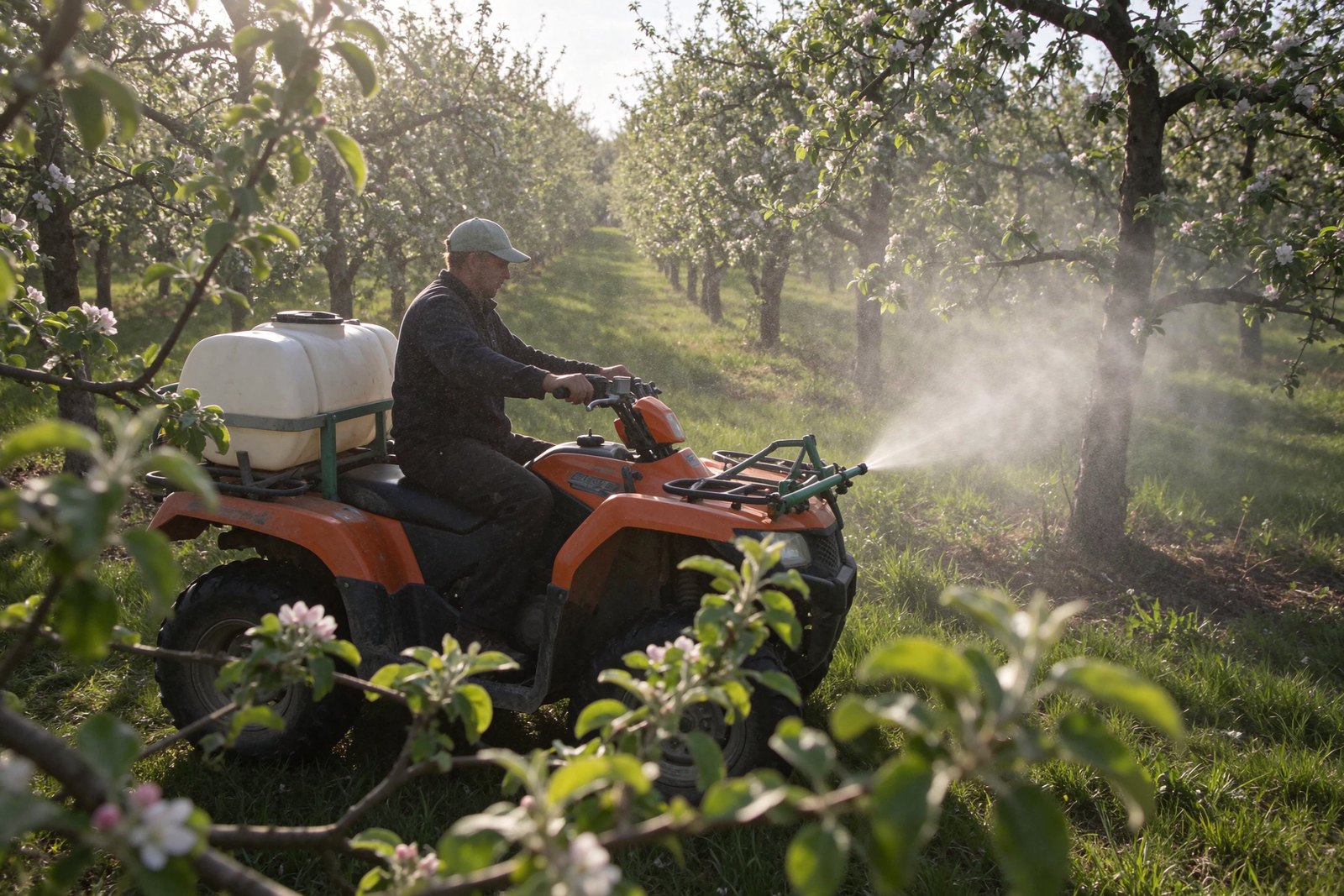
Orchard and vineyard buyers ask the wrong question first. The useful question is not “ATV or UTV” but “what is my row width, my canopy height and my steepest slope?” The answers usually settle the choice before payload enters the conversation.
Where an ATV wins
- Row width. A quad is narrower than a side-by-side, and a narrower machine means less pruning, fewer damaged posts and faster travel between rows.
- Canopy clearance. Low-trained orchards and tunnel trellis systems limit height. An ATV with a rider sits lower than a cabbed UTV.
- Soft ground. Lower ground pressure per wheel and lighter overall mass reduce rutting in wet inter-rows.
- Mounted implements. Spray tanks and spreaders mount on the rear rack or a three-point adaptor, with the operator able to see the nozzles.
Where a UTV wins
- Harvest haul. A cargo bed takes bins and crates that would need a trailer behind a quad.
- Two people plus tools. Picking crews and maintenance pairs travel together with equipment in the bed.
- Weather protection. Frost protection work happens at night and in the coldest hours; a cab changes who is willing to do it.
The compromise most growers reach
One narrow ATV for in-row spraying and mowing, plus one UTV or a tractor for hauling. The ATV does the repetitive passes; the bigger machine does the tonnage.
MODOU VEHICLE builds the in-row half of that combination: the 200cc MD-D2 for narrow rows and light loads, the 350cc MD-D3H for sprayer and trailer work, and the 72V MD-D2E for quiet, emission-free passes inside tunnels and polytunnels.
Three checks before you buy
Measure the narrowest gap on the property, including gate posts and trellis ends. Measure the lowest canopy height along the main row. Then calculate the loaded weight of the sprayer or spreader you intend to mount and compare it with the rack rating. Those three numbers eliminate most unsuitable machines in ten minutes.